Abdominal Wall Hernias
Ventral, Spigelian & Incisional Hernia Repair. Restoring your core strength with precision.
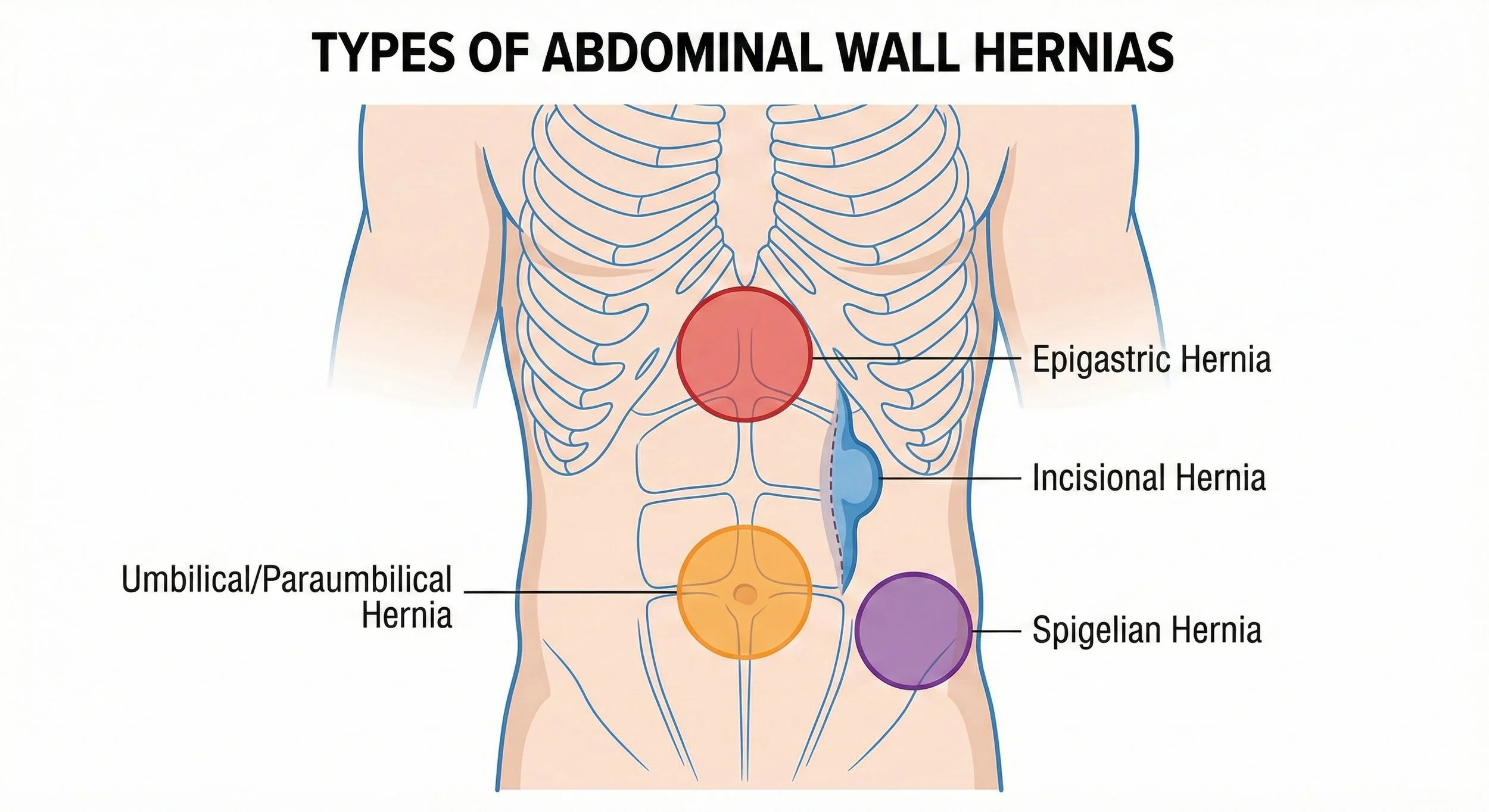
Types of Abdominal Hernias
Umbilical Hernia
The 'Belly Button' Hernia. This occurs at the natural weak point of the navel. While often small, they can trap fat or bowel, becoming painful and unsightly.
Paraumbilical Hernia
Occurring just above or below the navel. These are frequently associated with a weakening of the midline tissues (divarication) and often require a slightly wider repair to prevent recurrence.
Spigelian Hernia ("The Stealth Hernia")
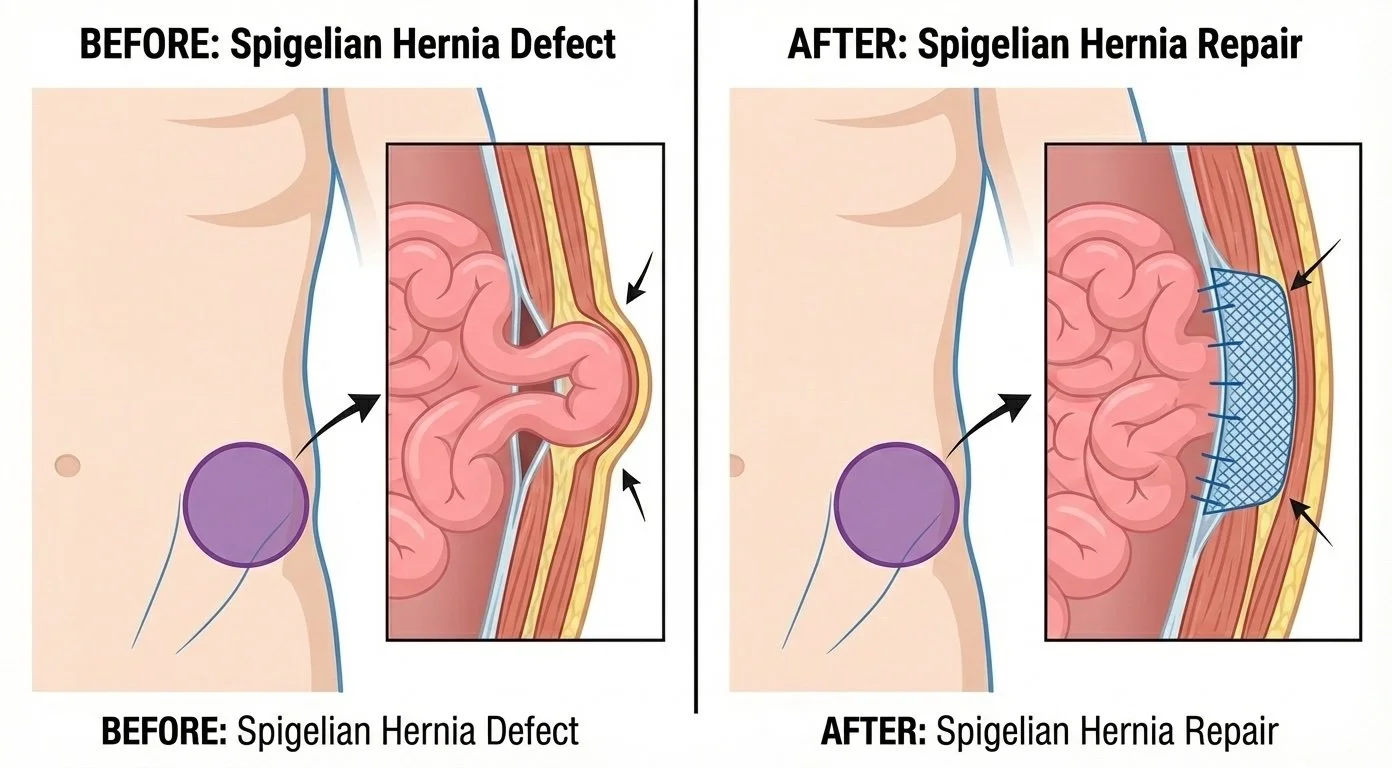
A rare hernia occurring on the side of the abdominal muscle (the semilunar line). Unlike others, it often presents with pain but no lump, making it hard to diagnose. It has a higher risk of strangulation and usually requires prompt surgical repair.
Incisional Hernia
A hernia forming through the scar of a previous abdominal surgery. These are complex structural failures of the abdominal wall. They rarely heal on their own and tend to enlarge over time, weakening your core function.
Surgical Approach
Expert Repair: Choosing the Right Technique for Your Anatomy
There is no "one size fits all." I am highly experienced in repair of these conditions and use a tailored combination of Laparoscopic (Keyhole) and Open techniques to ensure the strongest, most durable repair.
-
Because Spigelian hernias occur between the muscle layers, they are ideally suited for Laparoscopic (Keyhole) Repair.
The Technique: Using small incisions, I place a mesh behind the muscle layers to reinforce the weak spot from the inside.
The Benefit: This avoids cutting through the sensitive abdominal muscles, resulting in less pain and a faster return to activity compared to open surgery.
-
For hernias around the navel, the 'Gold Standard' is often a precision Open Repair.
Small Hernias: We can often close the defect with sutures alone, restoring the natural anatomy without leaving any foreign material (mesh) behind.
Larger Hernias: If a mesh is required, an open approach allows me to place it accurately beneath the defect, ensuring a solid structural repair while keeping the skin incision hidden within the natural curve of the belly button.
-
Hernias through previous scars are complex. They require a repair that not only fixes the hole but reinforces the weakened abdominal wall.
Small Incisional Hernias: These may be suitable for Keyhole Repair to minimize further scarring.
Complex/Larger Hernias: I typically perform an Open Anatomical Repair. This allows me to remove old scar tissue and reconstruct the abdominal wall under direct vision, ensuring the mesh is anchored securely for maximum long-term strength.
Risk Profile & Decision Making
Umbilical/Paraumbilical:
If it is small and asymptomatic, Watchful Waiting is a safe option. However, we monitor these for growth or pain, and if causing problems, elective repair is recommended to prevent emergency complications.
Spigelian & Incisional:
Due to the anatomy of these hernias, the risk of the bowel getting stuck (strangulation) is higher. We generally recommend elective repair for all Spigelian hernias and most symptomatic Incisional hernias. Fixing them early, while they are smaller, allows for a simpler operation and a smoother recovery.
Recovery Timeline
Day 0: Surgery (Day Case for Umbilical/Spigelian; Overnight stay may be required for larger Incisional).
Days 1–3: Rest and gentle movement. (Open repairs may feel tighter initially as the muscles are drawn back together).
Week 2: Return to driving and light desk work.
Week 4–6: Gradual return to gym and heavy lifting (Allowing the structural repair to bond).